
How to Search Sonoma County Court Records
Sonoma County Court records sit inside the Odyssey Portal, the Tyler-built public case search hosted for Sonoma Superior Court. The portal is branded "Superior Court of California, County of Sonoma" and covers civil, small claims, probate, family law, criminal, traffic, and related case files. Juvenile cases stay out of the open portal under state law. The court reaches the portal through its Case Portal page, which is the cleanest place to start. A look at the court's main court site sets the stage for what each division handles, and the home page screenshot below shows the court's top-level layout.

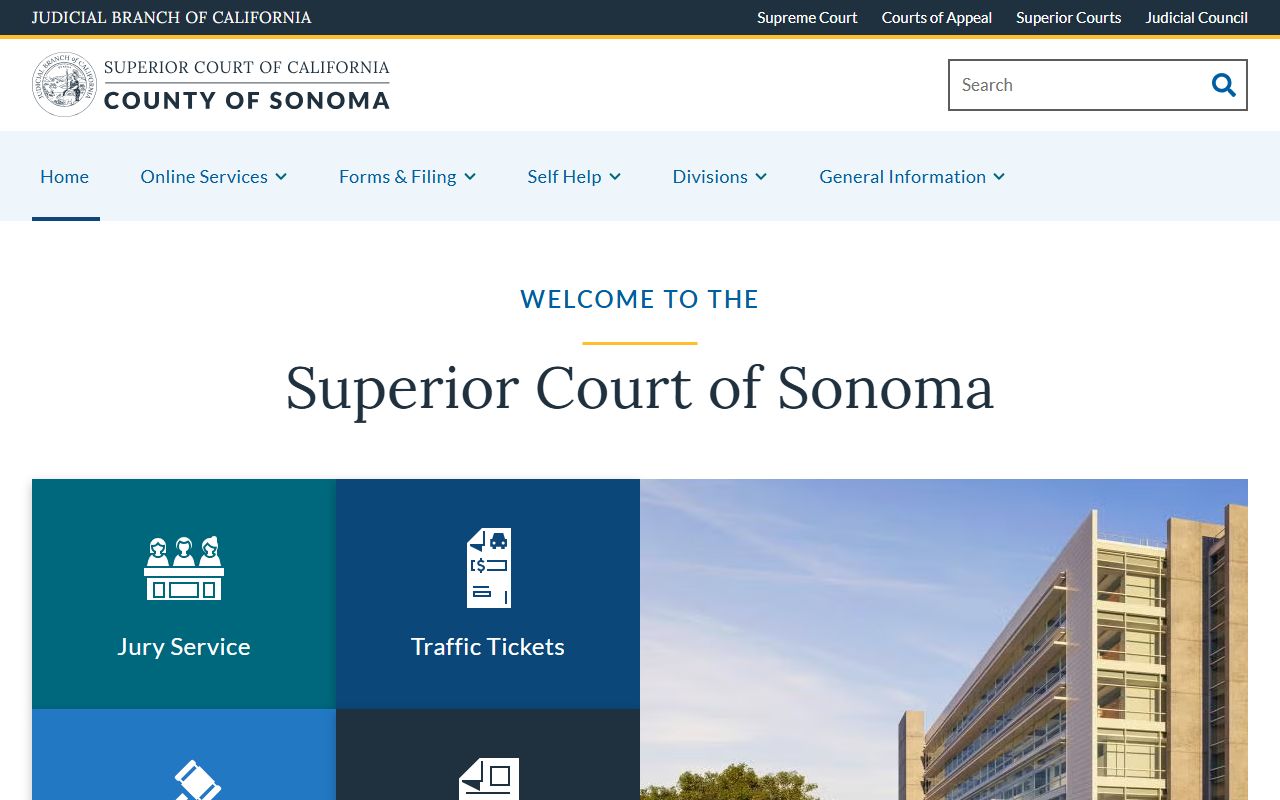
The portal lays out the same Sonoma Superior Court file the clerk staff uses at the counter. That makes it the right entry point for almost every Sonoma County Court records search.
A few things help before the search starts. A case number works best. A last name works well when paired with a date range. Sonoma criminal cases use formats like CR 24CR01416 or older SCR-style numbers seen in warrant data. For civil and family matters, party names plus filing year cut the result list down fast.
- Open the court's Case Portal page and click through to the Odyssey Portal at cmsportal.sonomacourt.org/IPortal/.
- Read the portal disclaimer and pick a search mode: name search, case number search, or calendar search.
- Enter the last name (try variants) or paste the full case number. Add a filing date range to cut noise.
- Pick a case type filter for civil, criminal, family, probate, small claims, or traffic to narrow Sonoma County Court records by docket family.
- Open the matching case to view the register of actions, hearings, and current status.
- Request a certified copy through the Clerk of the Superior Court when a stamped document is needed for a bank, school, or another court.
The Sonoma County Judicial System
California folds every trial court into one Superior Court per county. Sonoma has no separate municipal court, justice court, or stand-alone probate court. Probate, family law, and small claims are divisions of the Sonoma County Superior Court, not separate buildings with their own clerks. That keeps Sonoma County Court records under one roof for search purposes.
Appeals leave the trial court and head to the California Court of Appeal, First Appellate District. From there, discretionary review may reach the California Supreme Court. Federal matters that arise in Sonoma County go to the U.S. District Court for the Northern District of California, which sits outside the county court system.
Case flow: Sonoma County Superior Court › California Court of Appeal, First Appellate District › California Supreme Court
| Court | Jurisdiction | Case Types |
|---|---|---|
| California Supreme Court | Highest state court | Discretionary review, death penalty, attorney discipline |
| Court of Appeal, First Appellate District | Intermediate appeals for Sonoma | Appeals from Sonoma Superior Court rulings |
| Sonoma County Superior Court | Trial court of general jurisdiction | Civil, criminal, family, probate, juvenile, traffic, small claims |
| U.S. District Court, Northern District of California | Federal trial court for Sonoma | Federal civil and criminal, habeas, civil rights |
Sonoma County Courthouses
The court spreads work across a north Santa Rosa government campus rather than one historic square. Criminal calendars run out of the Hall of Justice at 600 Administration Drive, while civil, family, and probate matters operate at the Cleveland Avenue building. The County Clerk-Recorder is a short drive away on Fiscal Drive and handles marriage licenses, vital records, and recorded land documents. The court's locations and contacts page lists every division phone line and counter.
Hall of Justice
600 Administration Drive
Santa Rosa, CA 95403
Criminal, jury, general court
Civil and Family Law Courthouse
3055 Cleveland Avenue
Santa Rosa, CA 95403
Civil, family, probate, small claims
County Clerk-Recorder
585 Fiscal Drive, Room 103
Santa Rosa, CA 95403
(707) 565-3800
Types of Court Records Available in Sonoma County
Sonoma County Court records cover the full case mix of a unified trial court. Civil files run from limited civil collection actions to unlimited civil tort and contract suits. Family files cover divorce, custody, support, and domestic violence restraining orders. Criminal files split between felony and misdemeanor calendars. Probate files cover estates, trusts, guardianships, and conservatorships. Traffic and small claims sit on their own calendars but inside the same court. The court's civil division page and the civil division screenshot below show how the court frames each docket.

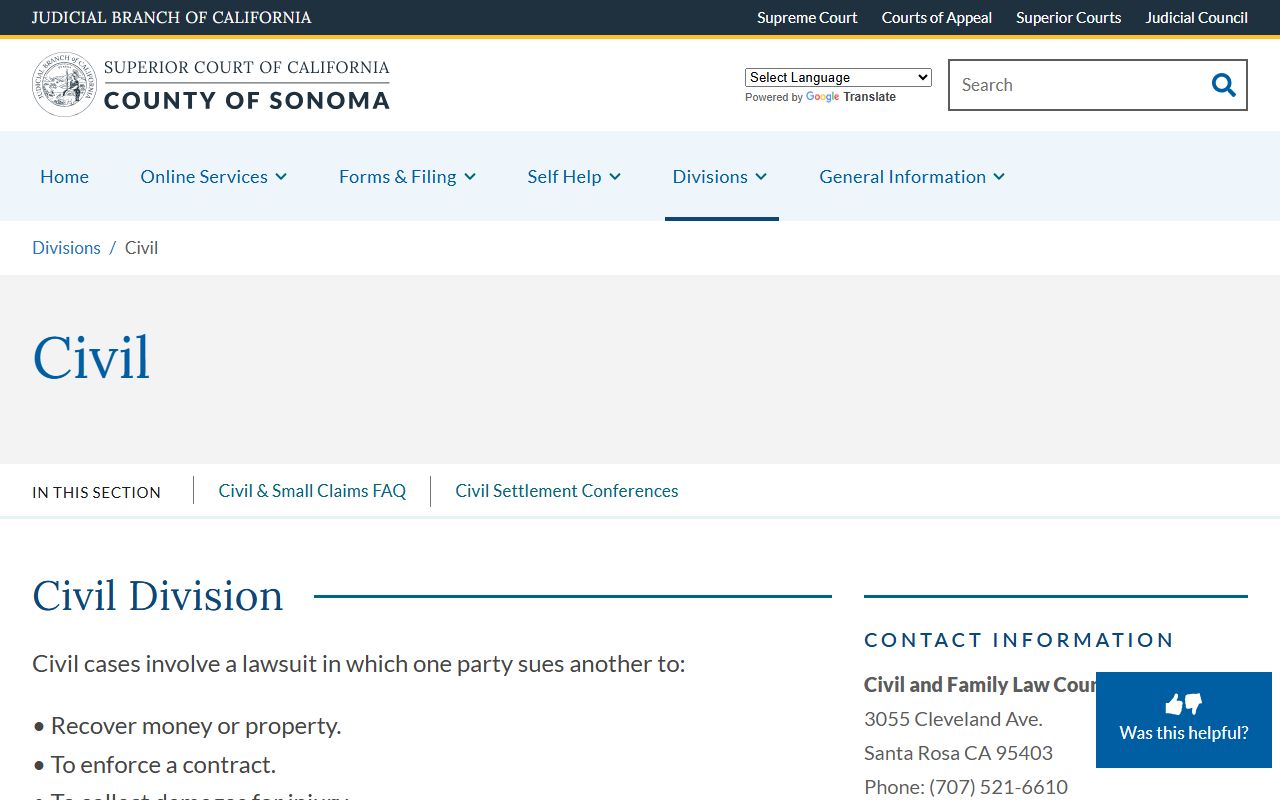
Each division has its own counter, phone line, and forms list. That matters when a search for Sonoma County Court records moves from screen to paper.
- Criminal records - felony and misdemeanor complaints, plea forms, sentencing minutes, and probation orders from the Sonoma criminal calendar.
- Civil records - limited and unlimited civil complaints, answers, motions, judgments, and writs filed at the Cleveland Avenue courthouse.
- Family and divorce records - dissolution petitions, custody orders, support orders, and domestic violence restraining orders.
- Probate records - wills lodged with the court, letters, inventories, accountings, and conservatorship files.
- Traffic records - infractions, traffic-school eligibility entries, failure-to-appear notes, and fine ledgers.
- Small claims - plaintiff claims, defendant claims, hearing notices, and small claims judgments.
What Sonoma County Court Records Show
A typical Sonoma County Court record on the Odyssey Portal opens with the case number, then the full case title, the filing date, and the assigned department. From there the register of actions lists each filing and each hearing in date order. The same fields show up in the warrant data linked from the Sheriff and in jail profile court-date tables. The case portal page notes that remote document access varies by case type, even when the case index is open.
| Field | What It Shows |
|---|---|
| Case Number | Court identifier such as CR 24CR01416 or older SCR-style numbers. |
| Filing Date | Date the initiating complaint, petition, or citation was filed. |
| Parties | Plaintiff and defendant, petitioner and respondent, or People v. defendant. |
| Charges / Cause | Penal Code or civil cause counts with statute references where listed. |
| Disposition | Status entries such as open, dismissed, plea entered, or judgment entered. |
| Sentence / Judgment | Custody time, probation terms, fines, restitution, or civil award. |
Personal identifiers stay out. Social Security numbers, full account numbers, minor names, and victim addresses are redacted. The portal also hides sealed material under court order.
Public Access Laws for Sonoma County Court Records
California uses two access systems that often get mixed up. The California Public Records Act covers county departments. Court records sit under a separate set of state rules, statutes, and constitutional principles. A request to the Sonoma County Administrator's office will not pull a court case file. A request to the court will not pull a county personnel file. Both systems start from a strong presumption of access, with named exemptions for privacy, juveniles, and sealed material.
Key Statutes:
California Government Code § 7920.000 - The California Public Records Act states that access to information about the people's business is a fundamental right.
California Government Code § 7922.000 - Public records are open unless a statute exempts them or nondisclosure clearly outweighs disclosure.
California Rule of Court 2.503 - Limits which trial court records can be made available through remote electronic access.
California Penal Code § 1203.4 - Allows dismissal relief after probation; the conviction is dismissed for many purposes but the record is not erased.
Welfare and Institutions Code § 827 - Keeps juvenile case files confidential except for parties, agencies, and people with court permission.
Sonoma also follows the public-interest balancing test in Government Code § 7922.535 for close calls. Court fees track Government Code § 70627, which sets trial court copy and certification charges.
Records That Are Restricted or Confidential
Some Sonoma County Court records are off the public portal by law. Juvenile dependency and delinquency files are confidential under Welfare and Institutions Code § 827. Adoption files are confidential under Family Code § 9200. Sealed records follow California Rule of Court 2.550, which forces the court to make written findings before sealing. Mental health proceedings, grand jury material, and victim identifiers also stay out of the public file.
Arrest-record sealing runs on its own track. Penal Code § 851.91 covers sealing after a non-conviction. Penal Code § 851.8 covers factual innocence petitions. A successful petition narrows public access but does not always remove the record from every database. People who want to view a sealed Sonoma file usually need a court order, party status, or statutory authority.
Specialty Courts in Sonoma County
Sonoma's specialty courts run inside the Superior Court as collaborative calendars. They serve people whose cases tie to substance use, mental health, or military trauma. Each program keeps the case under its underlying criminal or civil number, so the record stays in the same Odyssey case file.
Treatment-oriented criminal calendars take eligible defendants whose offenses connect to addiction. The court pairs frequent review hearings with probation supervision, drug testing, and treatment compliance. Mental health diversion under California Penal Code lets eligible defendants with qualifying diagnoses route into treatment instead of straight prosecution. Sonoma Behavioral Health, the District Attorney, and the Public Defender all sit at the table on these matters.
Veterans benefit from California provisions that recognize trauma, substance use, and mental health conditions tied to military service. The newest specialty addition is the CARE Act calendar, which launched in Sonoma on December 2, 2024. CARE Act petitions ask the civil court to set up a treatment plan for adults with untreated severe mental illness. Each program has its own forms and eligibility rules, and the court self-help office can route a person to the right calendar.
Sonoma County Sheriff and Jail
The Sonoma County Sheriff's Office runs the county jail and the public inmate search. Sheriff-Coroner Eddie Engram took office on January 2, 2023 as the county's 35th elected sheriff. The Sheriff hosts the Jail Inmate Search for current custody and the Warrant Search for active warrants. The Sheriff's home page screenshot below shows the agency's full menu of jail, warrant, and patrol services.

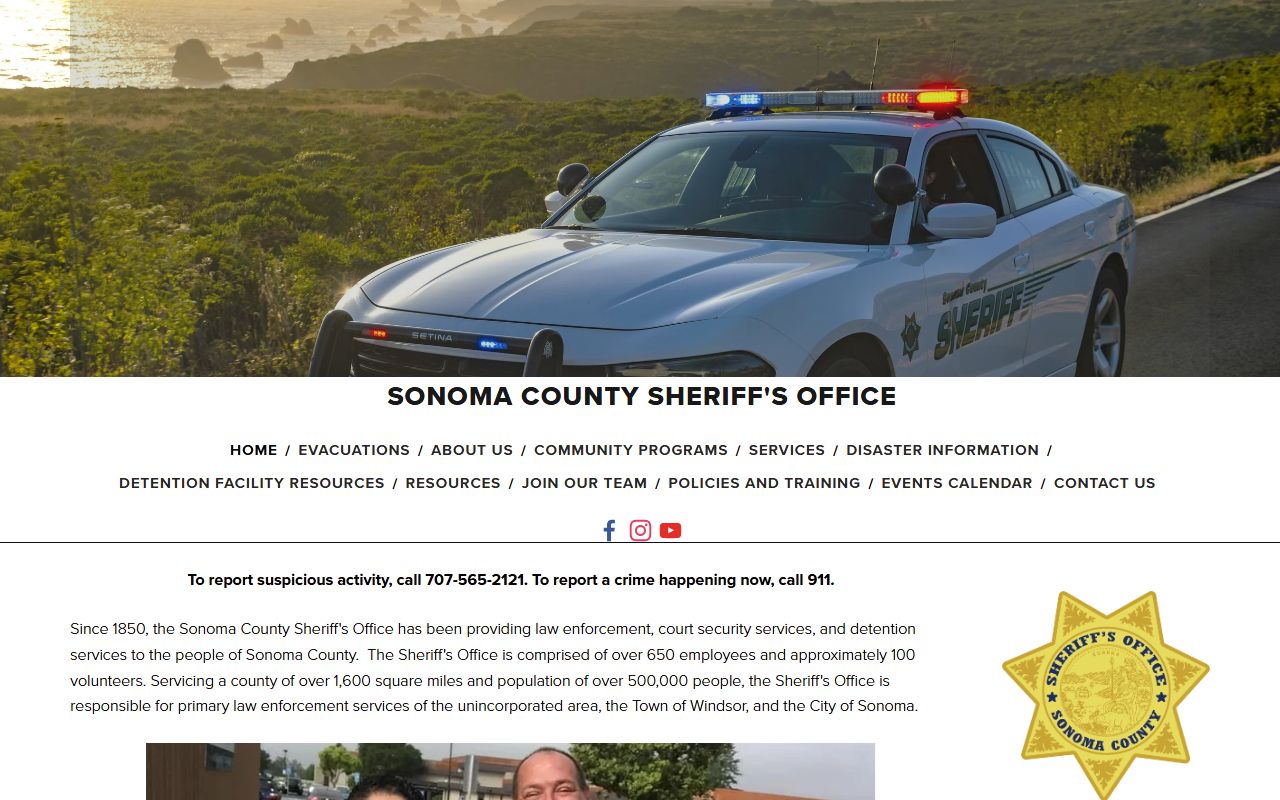
The jail roster covers the Main Adult Detention Facility at 2777 Ventura Avenue and the North County Detention Facility at 2254 Ordinance Road. The full booking record, including charges, court dates, and money-deposit rules, sits on the Sonoma County inmate records page. Active warrant entries, including FAILURE TO APPEAR and CONTEMPT OF COURT items with daily 5 PM updates, are covered on the warrant records page.
Marriage, Divorce, and Probate Records
Marriage licenses and certified marriage certificates are Clerk-Recorder records, not court records. Divorce, on the other hand, is a Superior Court family law case. Probate, including wills, estates, guardianships, and conservatorships, is a division of the Sonoma Superior Court. The probate division screenshot below comes from the court's probate page.

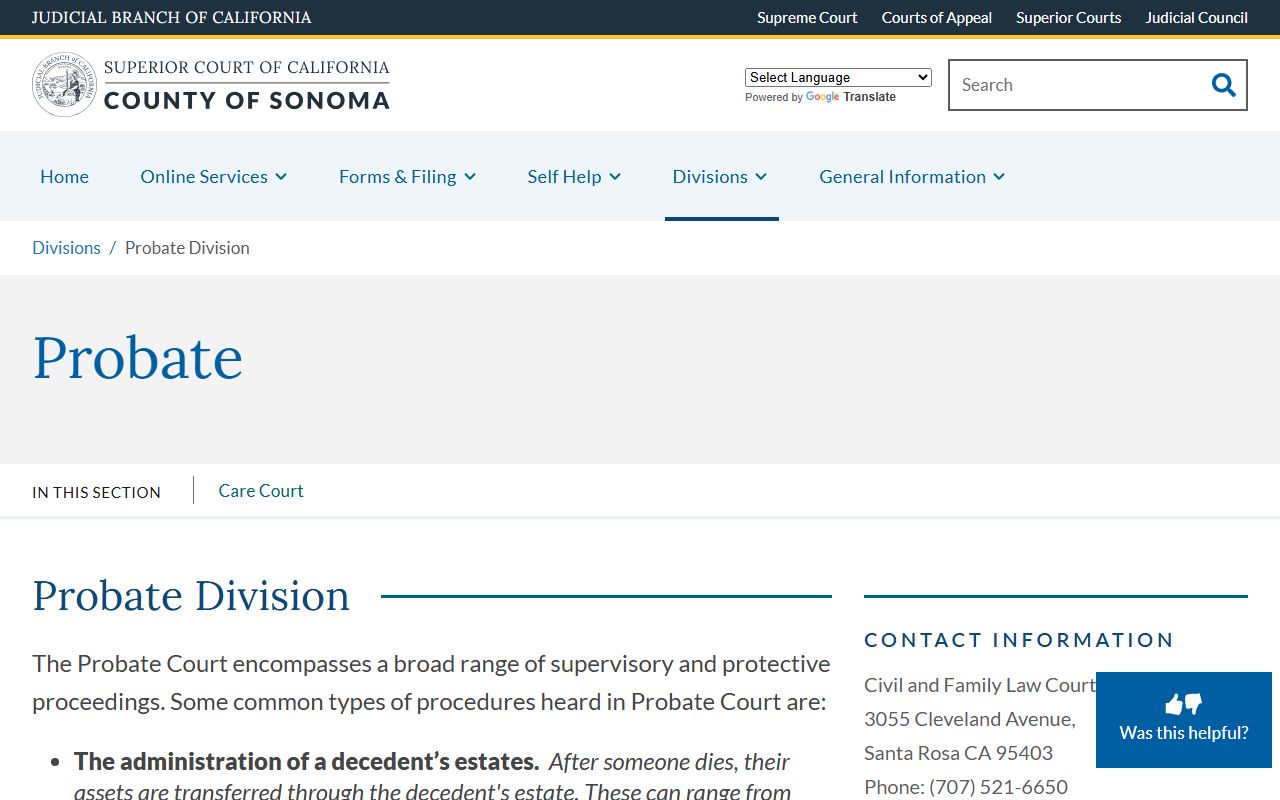
For marriage and divorce filings, see the Sonoma County marriage and divorce records page. For estate, trust, and conservator files, see the probate records page. A few probate terms come up often enough to spell out.
- Testator
- The person who made the will. Often the decedent in a probate case.
- Executor
- The person named in the will to administer the estate after letters issue.
- Conservator
- A court-appointed adult who manages the person, estate, or both for someone who cannot manage their own affairs.
Sonoma County Court Records Fees
Court copy and certification fees follow California Government Code § 70627. The statute sets the cap for plain copies, certified copies, the certification stamp, and the records search fee. The court's fee schedule page publishes the current numbers along with filing fees by case type.
| Item | Amount |
|---|---|
| Plain copy per page | Set under Gov. Code § 70627; see court fee schedule |
| Certified copy per page | Set under Gov. Code § 70627; see court fee schedule |
| Certification fee per document | Set under Gov. Code § 70627; see court fee schedule |
| Records search fee (over 10 minutes) | Set under Gov. Code § 70627; see court fee schedule |
Fee waivers are available for people who qualify based on income or public benefits. The court self-help office and the California Courts statewide forms cover the fee waiver process. Note: confirm current Sonoma copy and certification amounts on the court fee schedule page before paying, since the cap and add-on items shift by year.
How to Interpret Sonoma County Court Records
Docket entries use a clipped style. "ARR" stands for arraignment. "MIN ORD" stands for a minute order, the clerk's record of what happened in court that day. "FTA" stands for failure to appear and often triggers a bench warrant. "DISM" stands for dismissed. "DISP" stands for disposition. A line such as "PLEA: NG" means the defendant pled not guilty. A line such as "JT: PEO" means the People won a jury trial. Sonoma uses the same shorthand as most California superior courts.
Charges are not convictions. A criminal case can list felony counts at filing, then drop to misdemeanor counts after a plea, then end with a dismissal under Penal Code § 1203.4. The case file shows each step, but a casual reader can mistake the early charge for the final outcome. Always read down to the disposition line and the judgment entry before drawing a conclusion from Sonoma County Court records.
Civil cases work the same way. A complaint pleads a cause of action; a judgment resolves it. A demurrer is a motion that attacks the complaint on legal grounds. A motion for summary judgment asks the court to rule without a trial. The register of actions tracks every step in date order, which makes the file readable even without a lawyer.
Accuracy and Record Limitations
Online court data lags behind paper. New filings post after the clerk processes them, which can take days for high-volume calendars. Warrant data updates around 5 PM each day. The portal sometimes hides documents that are open at the counter. Anyone using Sonoma County Court records for a bond, a background check, or a court appearance should treat the online view as a starting point, not the last word.
Note: Always confirm a case status, hearing date, or warrant entry with the Clerk of the Superior Court or the Sheriff before relying on what the online record shows.
History of Sonoma County Courts
Sonoma County is one of California's original counties, created in 1850 when California joined the Union. The first state legislature passed an act prescribing county clerk duties on April 18, 1850, which set up the recording system that still runs today. Sonoma's court history follows the broader California arc from separate municipal and justice courts to a unified Superior Court. State trial-court unification ended the split, which is why modern Sonoma County Court records all sit under the Superior Court rather than scattered across municipal, justice, and county-court clerks.
The justice campus in north Santa Rosa pulls the court, the District Attorney, the Public Defender, and the jail into the same neighborhood. The Clerk-Recorder still flags older-record search quirks: search by abbreviation before 2010, search by exact name after January 1, 2010. That detail matters for genealogy, title work, and old civil suits.
Frequently Asked Questions
How do I search Sonoma County court records?
Open the Sonoma Superior Court Case Portal and click through to the Odyssey Portal. Use a case number when possible. Otherwise search by last name and narrow with a case type or date range. The portal is for court cases. It does not pull marriage licenses, deeds, or other recorded documents, which live with the Clerk-Recorder. Older files may need a call to the division clerk.
Is the County Clerk the same as the Clerk of the Superior Court?
No. The Clerk-Recorder is an elected office at 585 Fiscal Drive that handles marriage licenses, vital records, fictitious business names, and recorded land documents. The Clerk of the Superior Court is part of the court itself and handles civil, criminal, family, probate, juvenile, traffic, and small claims case filings. The two offices serve different needs and use different fee schedules.
Are Sonoma County divorce records public?
Divorce cases are family law cases in Sonoma Superior Court. The case index is public on the Odyssey Portal. Financial disclosures, custody evaluations, minor identifiers, and sealed papers may not be reachable from a remote terminal. Certified copies of the judgment can be ordered through the family law division at the Cleveland Avenue courthouse.
More answers are on the Sonoma County Court Records FAQ page.