
The California Public Records Act
California opens agency records to the public through the California Public Records Act, now codified at Government Code section 7920.000 and following. The act declares that access to information about the conduct of the people's business is a fundamental right of every person in this state. It binds all state and local agencies, including Sonoma County departments.
Under Government Code section 7922.000, public records are open unless an exemption applies. The agency must point to a statute or to the public-interest balancing test to withhold a record. The catchall balancing rule sits at Government Code section 7922.535, which lets an agency keep a record back only when the public interest in nondisclosure clearly outweighs disclosure.
Any person may request a county record. The CPRA does not require a reason for the request and does not require a California address. A requester does not need to be an attorney or a journalist. The right runs to every person.
The California Public Records Act sets the legislative purpose at the top of the statute. View the source at Government Code section 7920.000 on leginfo.legislature.ca.gov.
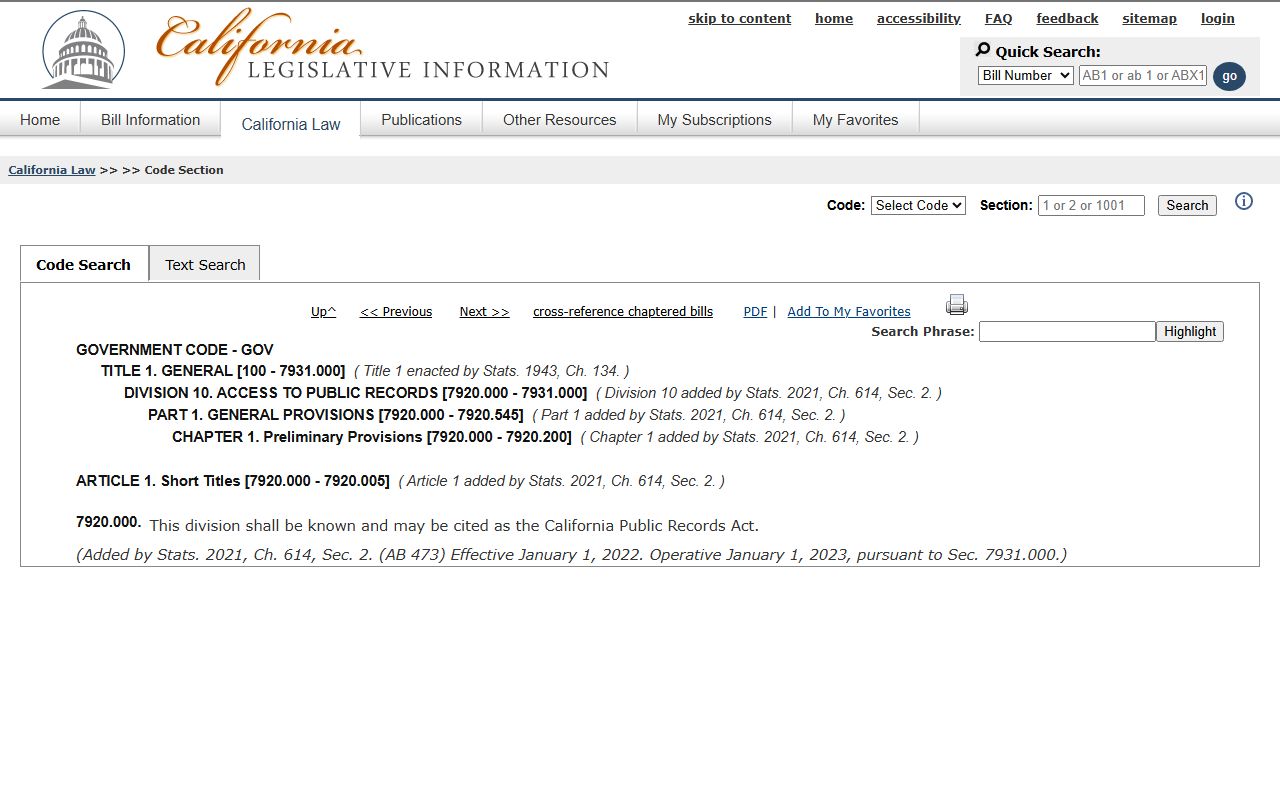
The page lays out the legal grounding for every Sonoma County public records request and is worth a quick read before filing.
Court Records vs County Agency Records
California has two separate open-records tracks. County department records flow through the CPRA. Court case files flow through the courts, the California Rules of Court, and the court clerk. Mixing the two leads to delays and wrong-channel denials.
For Sonoma Superior Court case files, use the court's own tools. The Sonoma Superior Court Odyssey Portal handles online case search. For copies, contact the Clerk of the Superior Court at the right division. Court copies follow Government Code section 70627 fee rules, not the CPRA.
For Sonoma County agency records, use the County Administrator's public records request page. The page routes the request to the right department. For recorded property and vital records, use the elected Clerk-Recorder-Assessor.
Note: A request for a criminal case file sent to the County Administrator will be routed back to the court clerk or simply denied as out of channel.
What Records the County Keeps
Sonoma County departments hold a broad range of public records. The list below is not exhaustive but covers the most common request topics. For court case files, see the Sonoma County court records page.
- Recorded property documents: deeds, liens, mortgages, releases, and maps held by the Clerk-Recorder.
- Vital records: birth, death, and marriage certificates held by the Clerk-Recorder.
- Marriage licenses and Fictitious Business Name filings handled by the County Clerk side of the office.
- Assessor data, property tax rolls, and parcel information from the Assessor.
- Board of Supervisors agendas, minutes, and resolutions.
- Sheriff's Office reports, jail data, and warrant data subject to law-enforcement exemptions.
- Public health, planning, building, and code enforcement records held by line departments.
The Clerk-Recorder-Assessor side and the court-clerk side are different offices. The court clerk works inside the Superior Court. The Clerk-Recorder works inside the County Clerk-Recorder-Assessor's office at 585 Fiscal Drive. The current elected Clerk-Recorder-Assessor is Deva Marie Proto.
How to File a Sonoma County Public Records Request
A CPRA request can be made in writing, by email, or through the county portal. Oral requests are allowed but harder to track. The county's online form puts the request in the right queue and creates a receipt.
- Pick the right office. Court files go to the court clerk. Property and vital records go to the Clerk-Recorder. Other county records go to the County Administrator's office.
- Describe the records in clear terms. Name the topic, the time range, the department, and the format you want.
- Use the county public records request form. Add your name and a contact email or address.
- Submit the form. The county logs the request and routes it to the holding department.
- Wait for the determination. The CPRA gives the agency 10 days to decide whether records will be disclosed, with one extension of up to 14 more days in unusual cases.
- Pay the duplication cost. The county collects copy fees before release for paper records. Electronic delivery may carry a smaller fee or no fee.
- Receive the records. The county releases the responsive records, redacts exempt parts, or sends a written denial with the legal basis.
Keep a copy of the request and any agency reply. If the agency misses the deadline or denies records that should be open, the reply is part of the record for an appeal or a writ action.
Sonoma County Public Records Request Form Fields
The county's request form gathers a few core items so the right department can respond. The table below lists the typical fields on the form.
| Field | Required | Notes |
|---|---|---|
| Requester's name | Yes | Used for the response and for any fee receipt. |
| Contact information | Yes | Email or mailing address. Phone is helpful but secondary. |
| Department or agency | Recommended | Pick the office that holds the record. Court records are not county CPRA records. |
| Description of records | Yes | Must reasonably describe identifiable records. Add date range and keywords. |
| Date range | Optional | Narrows the search and lowers cost. |
| Preferred delivery method | Optional | Electronic, inspection in person, or mail when offered. |
| Format preference | Optional | PDF or native format if known. |
| Submit | n/a | Sends the request and creates a tracking ticket. |
A clear, narrow description saves time. A request for "all emails from the last decade" usually triggers a clarification letter. A request for "emails between X and Y about the Z project, June 2025 through August 2025" lets the agency search and respond.
Sonoma County Response Timelines
The CPRA sets a 10-day response window for the agency to decide whether records will be released. The agency can extend that by up to 14 days for unusual circumstances such as a large volume of records, a need to consult with another office, or a need to search field offices. The extension must be in writing and must explain the reason.
A determination is not the same as actual production. The agency may give a target date for release after the determination. Production should be in a reasonable time. Late production can be challenged.
Note: The 10-day clock starts when the agency receives the request, not when the agency reads it.
Sonoma County Clerk-Recorder Records
The elected Clerk-Recorder-Assessor at 585 Fiscal Drive, Room 103, Santa Rosa, CA 95403 holds the county's recorded property documents and vital records. The office runs an Official Public Records search for deeds, liens, mortgages, maps, and other recorded titles. It is a separate office from the court clerk and is not where divorce, criminal, or civil court files are kept.
Search tip from the office: when looking for a record before 2010, use abbreviations. After January 1, 2010, search under the exact name of the person or company. Older index ranges include 1964 through 1989 and 1990 through 2010 cross-reference pages.
Office contact: Clerk-Recorder phone (707) 565-3800; 24-hour info line (707) 565-3700; California Relay 711; fax (707) 565-3905; email ClerkRecorder@sonomacounty.gov. Counter hours are Monday and Tuesday 8:00 AM to 5:00 PM, Wednesday 8:00 AM to 4:00 PM, Thursday and Friday 8:00 AM to 5:00 PM, with no fee transactions or document processing within 30 minutes of closing. Phone service runs Monday through Friday 9:00 AM to 4:00 PM.
The Sonoma County Clerk-Recorder Recorder Fee Schedule lists the per-document cost and the surcharge add-ons. View the source at the Recorder Fee Schedule page.
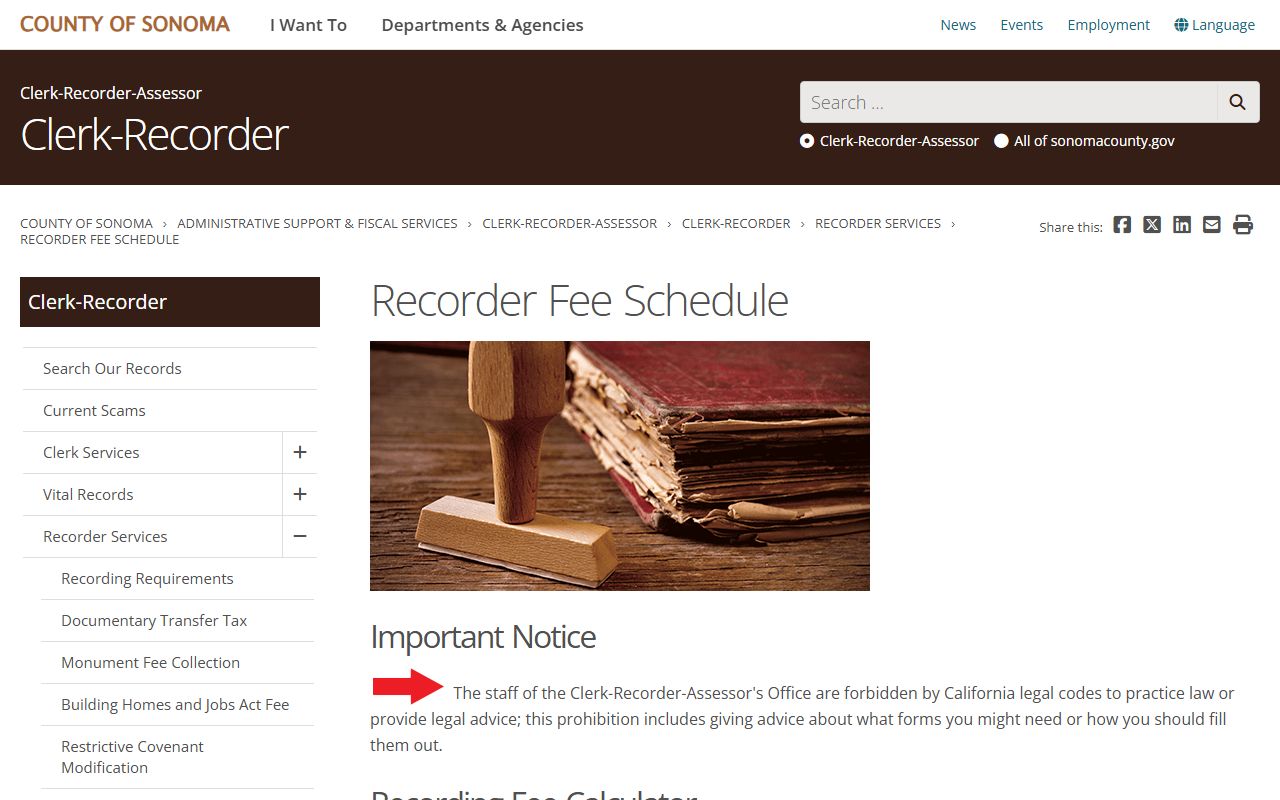
The same office posts a County Clerk fee schedule for marriage licenses, ceremonies, and clerk certifications.
Marriage and Vital Records
The Clerk-Recorder issues marriage licenses, performs civil ceremonies, and sells certified copies of birth, death, and marriage certificates. For licenses and ceremonies, see the marriage license page. For certified marriage certificates, see the marriage certificates page.
Divorce records are held by the court, not by the Clerk-Recorder. For divorce, custody, or support files, use the Sonoma County court records page or the Sonoma County marriage and divorce records page.
Death certificates and birth certificates have access limits set by state law. Authorized requesters can buy a certified copy; others may only be able to buy an informational copy that cannot be used to establish identity.
The Sonoma County Clerk-Recorder publishes a dedicated page for marriage certificate ordering. View the source at the Marriage Certificates page.
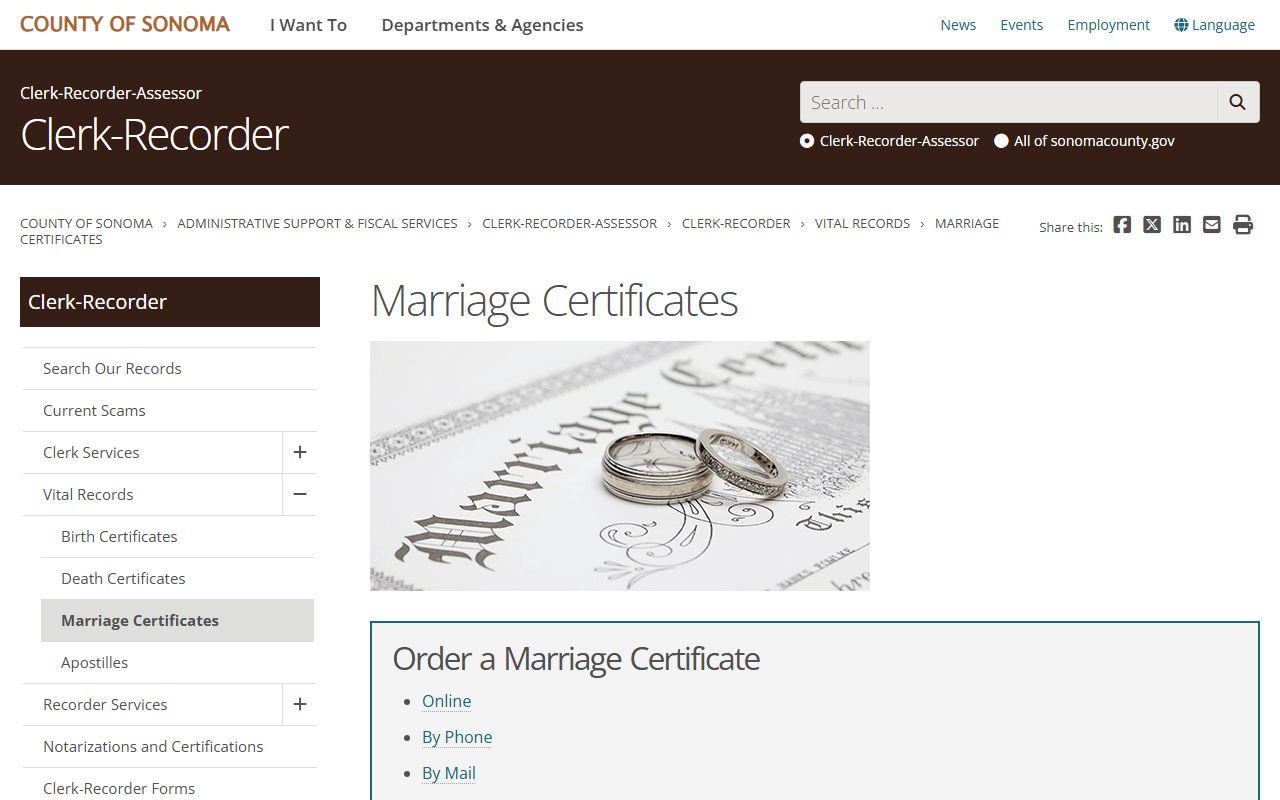
The page lists which family members may request a certified copy and how the office handles mail orders.
Fees for Sonoma County Public Records
CPRA agencies may charge the direct cost of duplication. Most agencies do not charge for the time spent finding the records, with limited statutory exceptions. The Clerk-Recorder uses its own fee schedules, set by statute and by the Board of Supervisors. Court copies use court fees under Government Code section 70627.
| Item | Charge Source |
|---|---|
| Plain copy of a court document | Court fee under Gov. Code section 70627 |
| Certified copy of a court document | Court fee under Gov. Code section 70627 |
| Exemplified court copy | Court fee under Gov. Code section 70627 |
| Plain copy of a county agency record | Agency duplication cost under CPRA |
| Recorded document copy | Recorder Fee Schedule |
| Marriage license | Clerk Fee Schedule |
| Certified marriage certificate | Recorder Fee Schedule |
Always check the current fee at the source before paying. The Clerk-Recorder accepts cash, checks, credit cards, and debit cards at the counter. For mail orders, the office posts payment guidance on the request pages.
Records That Are Exempt from Disclosure
Some county records are kept off the public side by statute or by the public-interest balancing test. The most common exemptions include investigative files of the Sheriff and District Attorney, personnel files, attorney-client communications, drafts that are not retained in the ordinary course, and trade secrets in vendor records.
Juvenile case files are confidential under Welfare and Institutions Code section 827. Adoption files are confidential under Family Code section 9200. Personal identifiers such as Social Security numbers, driver's license numbers, and account numbers are redacted under privacy rules in many record types.
The catchall balancing exemption at Government Code section 7922.535 lets the agency keep a record back only when the public interest in nondisclosure clearly outweighs disclosure. The agency carries the burden.
If a Sonoma County Records Request Is Denied
A denied requester can ask the agency to reconsider, can write to the County Counsel for a second look, or can file a civil suit under the CPRA for injunctive or declaratory relief. A prevailing requester can recover attorney fees and court costs. The court can review the records in camera before ruling.
Court records have their own path. A person denied access to a court file can ask the court to unseal under California Rule of Court 2.551 or can file a noticed motion in the case. For sealed records, see the rules at Rule 2.550.
Note: Document each step in writing. A clean paper trail is the strongest tool a requester has on appeal.
Older Sonoma County Recorded Records
Older recorded records may live in a different index than current records. The Clerk-Recorder maintains cross-reference indexes for 1964 through 1989 and for 1990 through 2010. For records older than 1964, plan a counter visit and bring as much info as possible: party names, the approximate year, and the document type.
The Clerk-Recorder counter staff can search the right index, pull the page or microfilm, and order a certified copy. For very old land records, the Assessor's office and the State Archives may also help with chain-of-title research.
For older court files such as long-closed divorces and probates, see the Sonoma County court records page. Those files do not live with the Clerk-Recorder.