
How to Search Sonoma County Probate Records
The main case lookup tool is the Sonoma Superior Court Odyssey Portal, branded "Superior Court of California, County of Sonoma." It is reached through the court's Case Portal page. The portal indexes Sonoma probate, trust, guardianship, and conservatorship cases. Search by case number when known. If only a name is known, search by the decedent, conservatee, or minor's last name and try common variants.
A probate case search returns the case header, hearings, the register of actions, and document links where remote access is allowed. Some probate documents are not online under California Rule of Court 2.503. Inventories with sensitive asset detail, medical capacity evidence, and investigator reports are common examples of records that may require a courthouse visit or a clerk request.
The court publishes the Probate Division page with current calendars, judge assignments, ex parte rules, and self-help contacts. View the source at the Sonoma Superior Court Probate Division page.
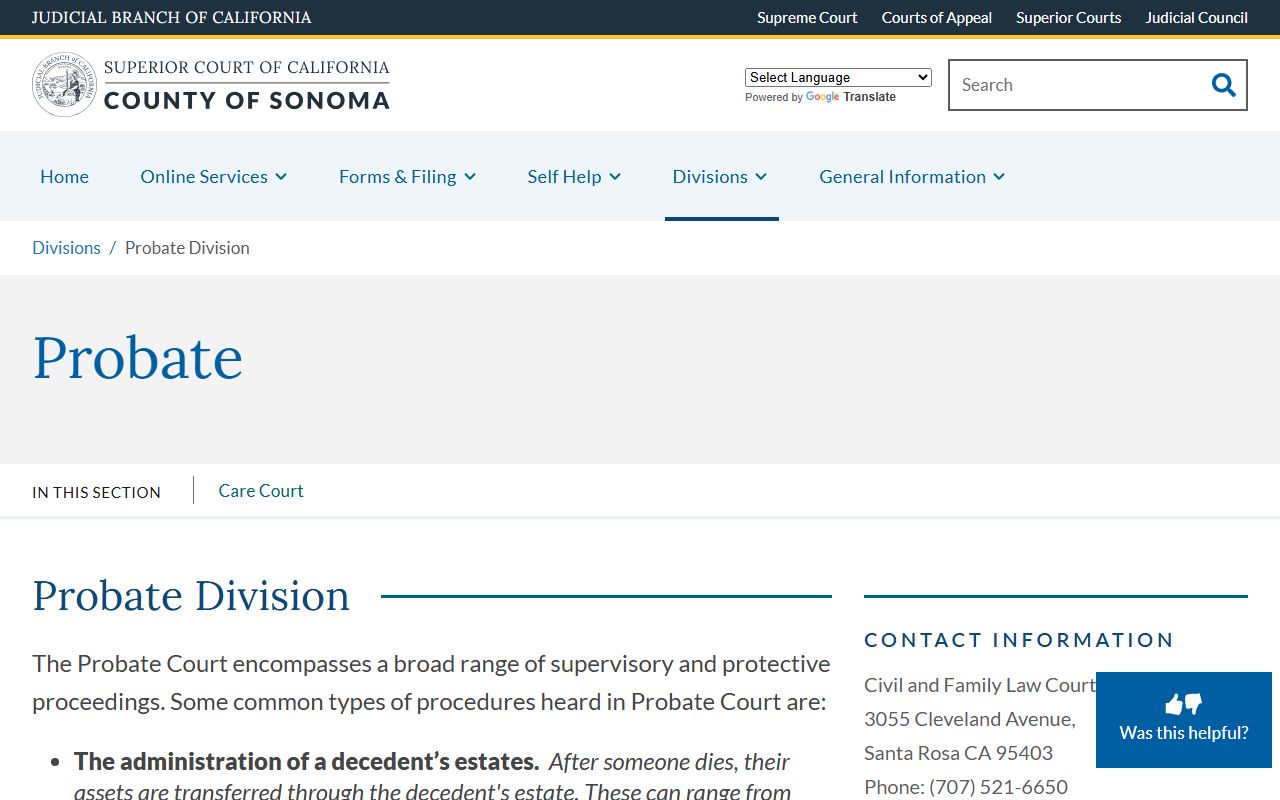
The same page links to local probate rules, the court forms page, and the self-help center for self-represented petitioners in estate, guardianship, and conservatorship cases.
Sonoma Superior Court Probate Division
California has a unified Superior Court in every county. Probate is a division of that single trial court, not a stand-alone probate court. Sonoma's Probate Division sits at the Civil and Family Law Courthouse at 3055 Cleveland Avenue in Santa Rosa. The same building holds the civil and family law divisions. The probate calendar covers decedent estates, trust petitions, guardianships of minors, and conservatorships of adults.
A probate filing is opened by petition. Common petitions include the petition to administer an estate, petition for letters of guardianship, petition for appointment of conservator, and various trust petitions. The court sets a hearing, gives required notice to heirs and interested parties, and rules at the hearing or based on submitted papers. Many probate matters move on the law-and-motion calendar, others on the ex parte calendar, and some on a long-cause trial date.
What Sonoma County Probate Files Contain
A Sonoma probate file usually has a sequence of papers from opening through final discharge. The exact mix changes by case type, but the public docket pattern is consistent.
- Petition for probate, petition for letters, or petition for guardianship or conservatorship.
- Original will lodged with the court if one exists.
- Notice of petition to administer the estate and proof of publication or mailing.
- Duties and liabilities acknowledgments signed by the personal representative.
- Order for probate and letters testamentary or letters of administration.
- Inventory and appraisal of estate assets prepared with a probate referee.
- Creditor claims and notice to creditors.
- Accountings, petitions for fees, and petitions for distribution.
- Final order, final distribution, and discharge of the personal representative.
For guardianship and conservatorship cases, expect investigator reports, capacity evaluations, and confidential filings that are not part of the public docket. The court rules limit who can see those filings, even though the case existence and basic orders are public.
Estate, Trust, Guardianship, and Conservatorship Cases
Probate is broader than just wills. The same division handles four main case families. Each has its own filing path, notice rules, and forms. The portal sorts cases by case type, so the right filter narrows results fast.
Decedent estates include both testate cases, where the person left a will, and intestate cases, where the person died without one. A personal representative is appointed to gather assets, pay debts, and distribute what remains. Trust petitions ask the court to confirm, modify, or terminate a trust, or to address trustee actions. Trust accountings may also be filed.
Guardianship cases involve minors. The court appoints a guardian of the person, of the estate, or both. A guardianship may be temporary, while a permanent guardianship lasts until the minor turns 18 or the court terminates it. Conservatorship cases involve adults who cannot manage personal care or finances. California has probate conservatorships under the Probate Code and LPS conservatorships for serious mental illness under the Welfare and Institutions Code; the LPS file is handled separately and is largely confidential.
Probate Search Through the Odyssey Portal
The Odyssey Portal exposes the same standard fields for probate that it does for other case types. The table below lists what to expect. Some fields appear only after picking a search mode.
| Field Label | Type | Required | Notes / Format |
|---|---|---|---|
| Case Number | text | Optional / best | Use the exact probate case number when known. |
| Decedent / Conservatee / Minor Name | text | Conditional | Last name and first name search; try spelling variants. |
| Case Type | dropdown | Optional | Probate, trust, guardianship, or conservatorship filter. |
| Filing Date Range | date range | Optional | Helps with older or common names. |
| Search | button | n/a | Runs the Odyssey Portal search. |
Tight filters return short, useful lists. Start with case type set to probate, a date range covering the year of death or filing, and the last name only. If nothing comes back, widen the date range, then drop the case type filter, then try a name variant. Probate cases for common surnames may produce many hits, so be ready to scan a long results page.
California Small Estate Procedure
Not every estate needs a full probate case. California's small estate procedure under Probate Code section 13100 lets a successor collect personal property of a deceased person using a sworn affidavit when the estate's value is below the statutory threshold. The threshold changes by statute, so the current limit must be checked before relying on the affidavit. Real property has its own simplified procedures.
The small estate affidavit is used after the statutory waiting period and when no probate has been opened. Banks, the DMV, and other holders accept the affidavit if the requirements are met. Formal probate is still required when the estate exceeds the small-estate limit, when there is real property that cannot pass by another mechanism, when there is a dispute, or when letters are needed for a personal representative to act.
The California Legislative Information page hosts the full text of Probate Code section 13100 and its surrounding small estate procedures. View the source at the Probate Code section 13100 page.
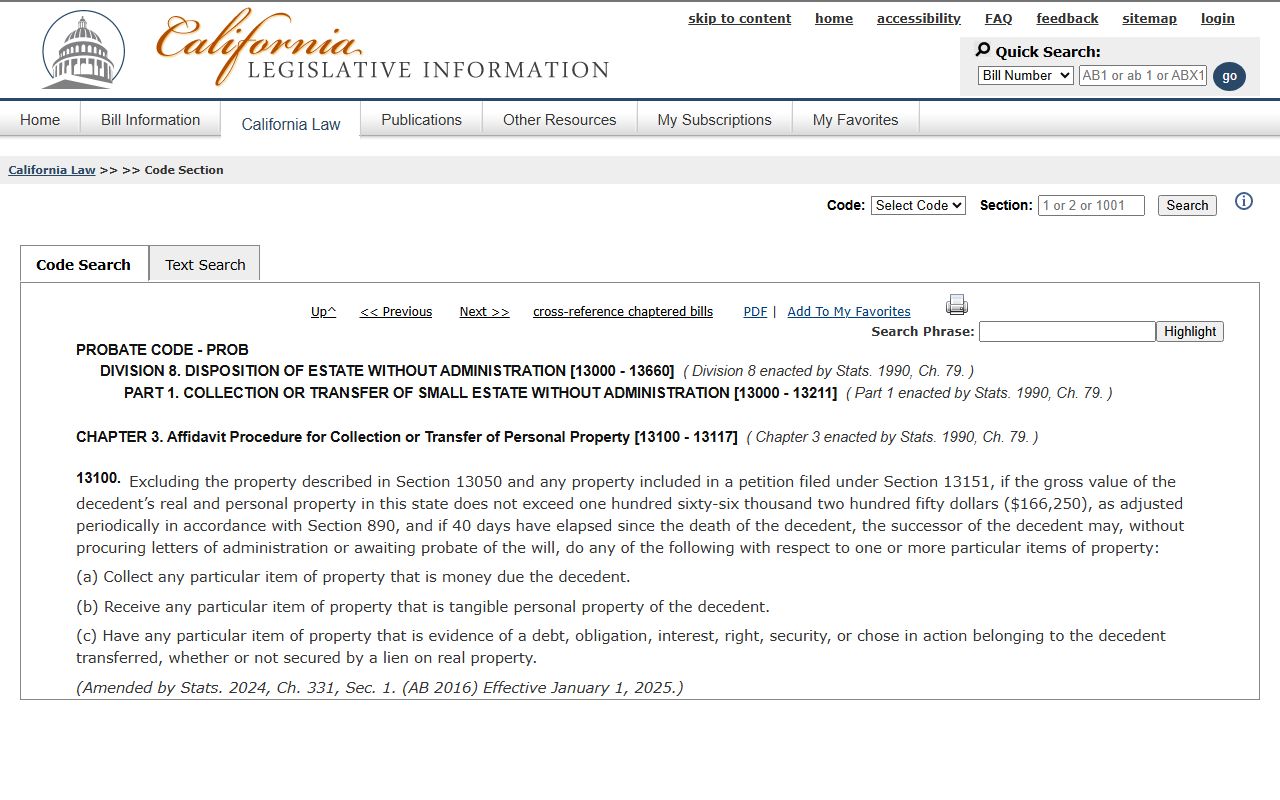
The official statute page is the right source for the current dollar threshold, the waiting period, and the exact language used in the affidavit form.
Probate Glossary
Probate uses its own vocabulary. Many terms come from old common-law usage and may not match plain English. The list below covers the most common terms seen in Sonoma probate files.
- Testator
- A person who made a valid will. The female form testatrix is no longer required by California statute.
- Executor
- The personal representative named in a will to carry out its terms after the testator dies.
- Administrator
- The personal representative appointed by the court when there is no will or when the named executor cannot serve.
- Intestate
- Dying without a valid will. The estate then passes under California intestate succession rules.
- Guardianship
- A probate case in which the court appoints an adult to care for the person, the estate, or both, of a minor.
- Conservatorship
- A probate case in which the court appoints a conservator to handle the person or finances of an adult who cannot do so safely.
Other useful terms include letters testamentary, letters of administration, inventory and appraisal, probate referee, notice of petition, creditor claim, accounting, and final distribution. Each marks a step in the file from opening through close.
How Probate Works in Sonoma County
Probate is a sequence of formal steps. Each step is on the docket and is part of the public record once filed, except for sealed or confidential pieces. The list below outlines a typical Sonoma decedent estate. Guardianship and conservatorship steps look similar but use different forms.
- Decide whether a probate case is needed or whether small-estate procedures apply under Probate Code section 13100.
- Lodge the original will with the Sonoma Superior Court if one exists.
- File a petition for probate or the appropriate guardianship, conservatorship, or trust petition, with required attachments.
- Pay the filing fee or apply for a fee waiver using Judicial Council form FW-001.
- Give the required notice to heirs, beneficiaries, and other interested parties, and publish notice when required.
- Attend the noticed hearing; if granted, obtain letters testamentary, letters of administration, or other appointment letters.
- Inventory and appraise assets with the assigned probate referee, and provide notice to creditors.
- File the accounting or report and the petition for final distribution.
- The court approves distribution, signs the discharge order, and the case is closed.
Most uncontested probate cases last several months to over a year, depending on calendar dates, creditor periods, and any tax issues. Contested cases take longer. Some matters, such as a will contest or a conservatorship objection, become full trials with witnesses and evidence.
Fees for Probate Records
Probate fees fall into two groups. Filing fees for petitions and motions are set by the Government Code and posted on the court fee schedule. Copy and certification fees follow Government Code section 70627. Probate referee fees and any required bond premiums are separate.
| Item | Amount |
|---|---|
| Petition for probate or letters | Per court fee schedule under the Government Code |
| Petition for guardianship | Per court fee schedule |
| Petition for conservatorship | Per court fee schedule |
| Trust petition | Per court fee schedule |
| Plain copy per page | Per Gov. Code § 70627 |
| Certified copy per page | Per Gov. Code § 70627 |
| Certification fee per document | Per Gov. Code § 70627 |
| Exemplification | Per Gov. Code § 70627 |
Certified copies of letters are usually needed by banks, brokerages, and title companies before they will release assets or accept a personal representative's instructions. Plan to order two or three certified copies of the letters at appointment time.
Fee waivers are available for petitioners who meet income limits. Statutory personal representative compensation and attorney fees in formal probate are set by Probate Code formulas based on estate value and require court approval before payment.
Restricted Probate Materials
Not every probate document is public. Capacity evidence, medical records, mental-health evaluations, and investigator reports are usually restricted. Minor guardianship records have extra protections under the Welfare and Institutions Code when overlap with juvenile court exists. Confidential addresses for protected parties are redacted when filed.
Sealed materials follow California Rule of Court 2.550 and Rule 2.551. To view a restricted probate filing, a person must usually petition the court, give notice, and show good cause. The court rules on access through a written order. Counter staff cannot release confidential materials without that order.
Public access still covers the case existence, the basic orders, the final accounting in many cases, and the personal representative's identity. Researchers and family members can confirm whether a Sonoma probate was opened and how it closed, even when individual exhibits are protected.
Where Sonoma Probate Cases Are Filed
Probate cases are filed and heard at the Civil and Family Law Courthouse. The probate clerk handles new petitions, lodging of wills, certified copies of letters, and case status questions. The Hall of Justice on Administration Drive is the main court campus but is not where probate is filed.
Civil and Family Law Courthouse (Probate Division)
Sonoma County Superior Court
3055 Cleveland Avenue
Santa Rosa, CA 95403
Probate Division
Self-represented petitioners can also use the Sonoma Superior Court self-help center for probate questions, packets, and forms guidance. The statewide California Courts self-help portal hosts the Judicial Council forms used in every Sonoma probate.
Note: Self-help staff can explain probate procedure and check forms, but they cannot give legal advice or represent any party in a hearing.