
Sonoma County Superior Court Overview
California uses a unified Superior Court in every county. Sonoma's court is the Superior Court of California, County of Sonoma. It is the trial court of general jurisdiction. The same court hears felonies, misdemeanors, civil unlimited and limited cases, family law, probate, juvenile, traffic infractions, small claims, and unlawful detainer. Specialty calendars handle veterans diversion, mental health diversion, and treatment-oriented criminal cases when eligible. Appeals go to the California Court of Appeal, First Appellate District, and then potentially to the California Supreme Court.
The court publishes its locations, hours, and division contacts on the official court site. View the source at the Sonoma Superior Court home page.
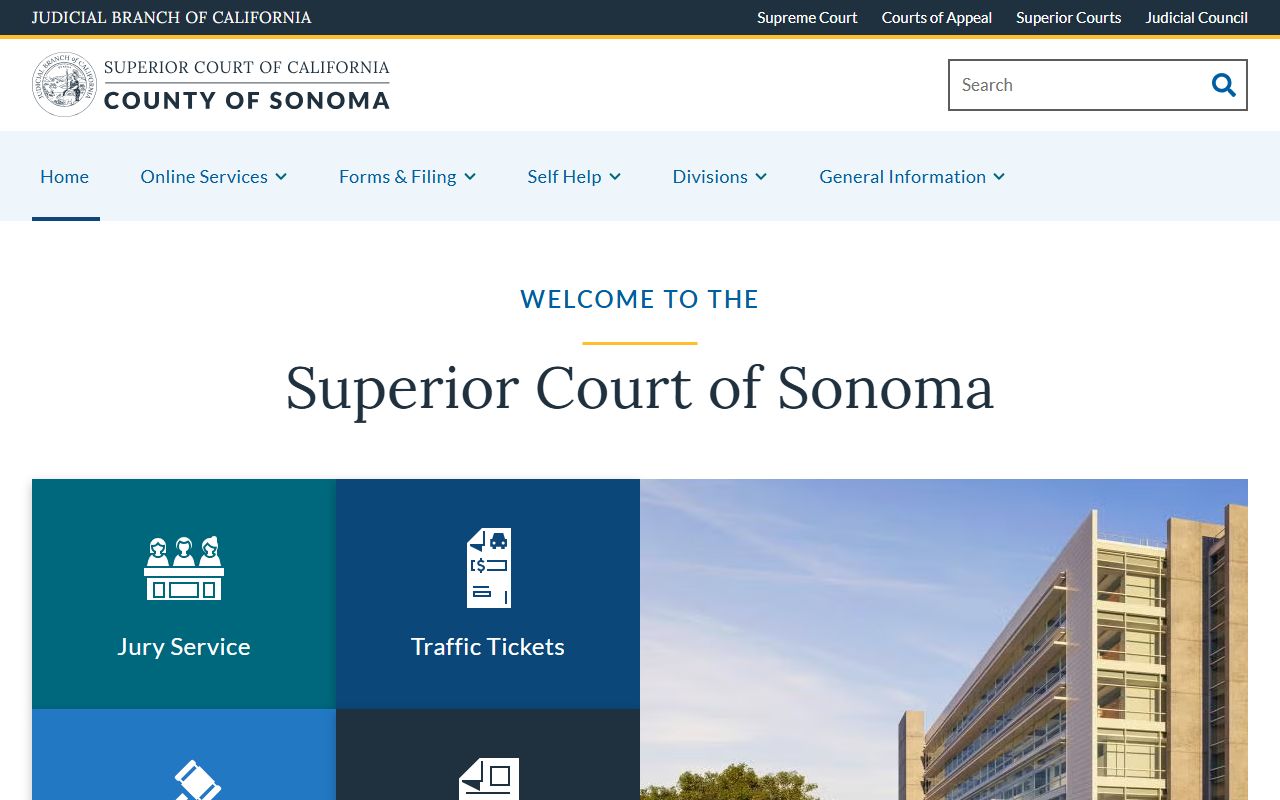
The home page links to divisions, online services, forms, fee schedules, and the self-help center, which are the main entry points for any Sonoma court records search.
No County District Court in California
California does not have a county district court. Many other states divide trial work among district, county, justice, and municipal courts. California does not. When users look for a "Sonoma County District Court," the right local court is the Sonoma County Superior Court. The same court handles what other states would assign to a county court at law, a probate court, a justice of the peace court, or a municipal court.
Federal district matters are a separate path. The U.S. District Court for the Northern District of California covers Sonoma County for federal civil, criminal, and federal-question cases. Federal cases are not in Sonoma Superior Court. The state and federal paths do not overlap on a single case.
Older California cases sometimes reference municipal courts. California unified its trial courts in the late 1990s and the early 2000s, and municipal courts were merged into the superior courts. Sonoma has not had a separate municipal court since unification. Historical records from before unification may still bear municipal court captions.
Sonoma Superior Court Divisions
The court is organized by division. Each division has its own clerk counter, calendar, judges, and forms. The same Odyssey Portal indexes them all. The table below lists the main divisions, their addresses in Santa Rosa, and the case types each handles.
| Court / Division | Address | Jurisdiction |
|---|---|---|
| Sonoma Superior Court - Hall of Justice | 600 Administration Drive, Santa Rosa, CA 95403 | Criminal, traffic, jury, and general court functions by department. |
| Civil and Family Law Courthouse | 3055 Cleveland Avenue, Santa Rosa, CA 95403 | Civil, family law, small claims, unlawful detainer, and probate counters. |
| Criminal Division | 600 Administration Drive, Santa Rosa, CA 95403 | Felony and misdemeanor adult criminal cases. |
| Civil Division | 3055 Cleveland Avenue, Santa Rosa, CA 95403 | Limited and unlimited civil cases and assigned civil harassment matters. |
| Family Law Division | 3055 Cleveland Avenue, Santa Rosa, CA 95403 | Divorce, custody, support, parentage, and domestic violence restraining orders. |
| Probate Division | 3055 Cleveland Avenue, Santa Rosa, CA 95403 | Estates, trusts, guardianships, and conservatorships. |
| Juvenile Division | Juvenile court location per the Sonoma court locations page | Dependency and delinquency, with confidentiality under WIC 827. |
| Small Claims and Traffic | Calendars within the Superior Court | Self-represented small claims cases and traffic infractions. |
Picking the right counter saves time. A Sonoma criminal case opens at the Hall of Justice; a divorce or probate opens at Cleveland Avenue. The court's locations and contacts page is the official source for direct division lines and any updated room numbers.
Civil and Family Law Division
The Civil Division hears limited and unlimited civil cases. Limited civil covers claims up to a statutory dollar cap. Unlimited civil covers larger claims. Common civil case types include breach of contract, personal injury, property damage, real property, civil harassment, and unlawful detainer. The court publishes its civil division page for current rules, the assigned departments, and ex parte procedures.
The Family Law Division hears dissolution of marriage, legal separation, nullity, parentage, custody, visitation, child support, spousal support, and domestic violence restraining orders. California is a no-fault divorce state under the Family Code, and Sonoma follows the same six-month waiting rule from service to judgment.
The court posts both divisions online. View the source at the Sonoma Superior Court Civil Division page.
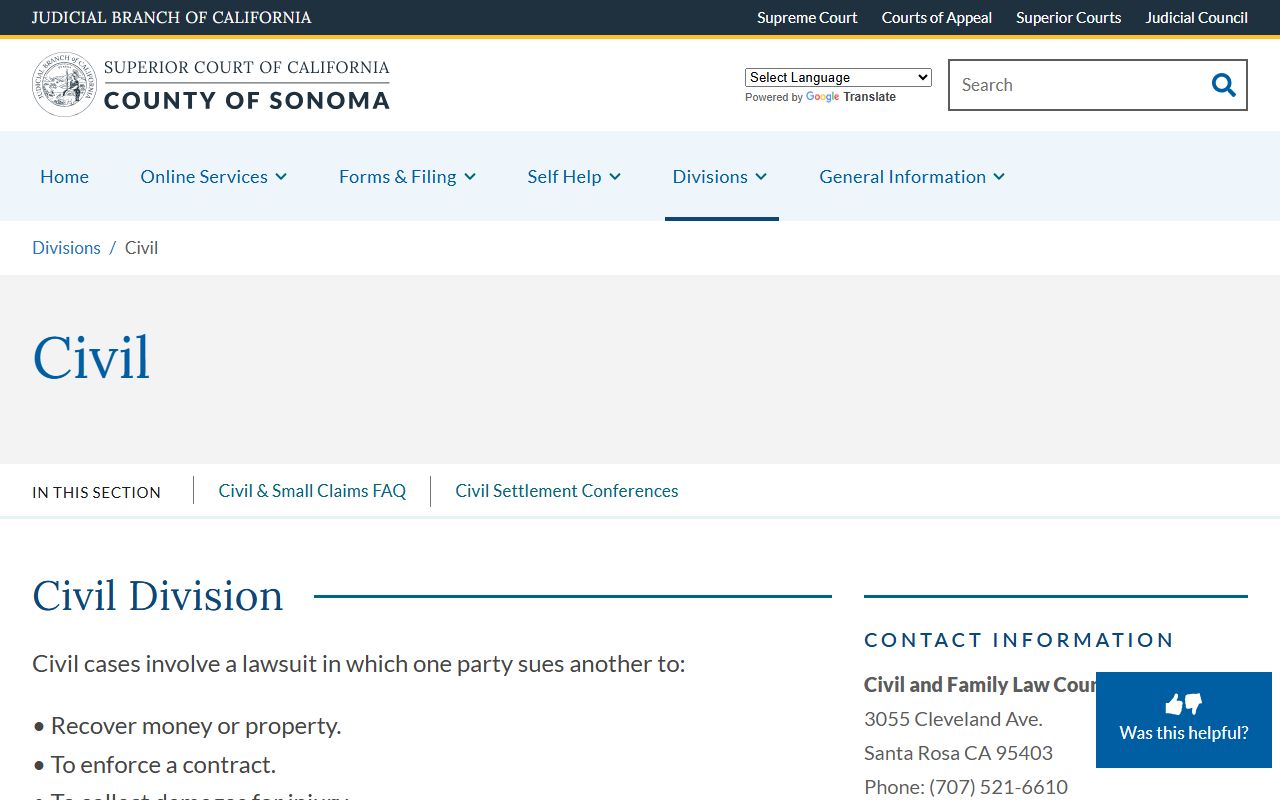
The Civil Division page lists current calendars, judge assignments, and the local rules that govern Sonoma civil case management.
Criminal Division
The Criminal Division handles felony and misdemeanor adult criminal cases. The criminal calendar starts at arraignment after arrest or charging by the Sonoma County District Attorney. The case then moves through pretrial hearings, motions, trial or plea, sentencing, and any post-conviction activity. The Hall of Justice at 600 Administration Drive is the criminal courthouse for Sonoma County.
The District Attorney's Office is at 600 Administration Drive, Room 212J, with a main line of (707) 565-2311. The Public Defender's Office is at 600 Administration Drive, Room 111J, with a main line of (707) 565-2791 and a juvenile unit at (707) 565-6304. Indigent defendants apply for appointed counsel at arraignment or through court financial screening.
Criminal case files cover complaints, informations, plea forms, sentencing minutes, probation orders, restitution orders, and post-conviction filings. Some records, like sealed arrest records under Penal Code section 851.91, are restricted. Dismissal relief under Penal Code section 1203.4 is available for many qualifying convictions after probation completion.
Probate, Juvenile, and Small Claims
Probate is a Sonoma Superior Court division, not a separate court. The Probate Division handles estates, trusts, guardianships, and conservatorships at the Civil and Family Law Courthouse. Small estate procedures under Probate Code section 13100 allow many smaller estates to be settled by affidavit without opening a full probate case. For deeper coverage see Sonoma County probate records.
The Juvenile Division handles delinquency cases for minors charged with offenses and dependency cases involving child welfare. Records are confidential under Welfare and Institutions Code section 827. Public access is limited to parties, attorneys, listed agencies, and persons authorized by court order.
The Small Claims calendar handles disputes up to the statutory limit for self-represented parties. Attorneys generally cannot appear at the initial hearing. Judgments may be appealed to a different judicial officer for a trial de novo. Traffic infractions also sit in the Superior Court under the unified system, with online services for payment and traffic school sign-up.
Specialty and Collaborative Courts
Sonoma operates several specialty calendars within the Superior Court. These are not separate courts. They are problem-solving programs where the same judges, prosecutors, defenders, probation officers, and treatment partners work a smaller, more intensive caseload.
Drug or treatment court is for defendants whose criminal conduct ties to substance use. Eligibility usually requires a qualifying case, a clinical assessment, willingness to participate, frequent court review, probation supervision, and drug testing. Mental health diversion allows eligible defendants with qualifying diagnosed disorders to seek treatment instead of standard prosecution when statutory conditions are met. Veterans diversion or veterans treatment options exist for service members and veterans whose military service ties to the conduct charged. Family or dependency treatment models connect child welfare, treatment, and court oversight.
Specialty court records remain part of the Superior Court file system. Treatment-specific details may be confidential, but the case existence, hearings, and basic orders are typically public docket entries.
How Cases Move Through the Sonoma Superior Court
Cases move through clear, named steps. Criminal and civil paths share some structure but differ in early stages. The list below tracks the typical flow on the criminal side and the civil side.
Criminal flow: Arrest › Booking › Filing by DA › Arraignment › Pretrial Conferences › Preliminary Hearing for Felonies › Trial or Plea › Sentencing › Appeal
Civil flow: Complaint Filed › Service of Summons › Answer › Case Management Conference › Discovery › Motions › Mediation or Settlement Conference › Trial › Judgment › Appeal
Appeals path: Sonoma County Superior Court › California Court of Appeal, First Appellate District › California Supreme Court
Each step is on the docket once it happens. The Odyssey Portal lists hearings, filings, minute orders, and dispositions in the register of actions. Some events happen off the record, like settlement negotiations, but the resulting order or dismissal will appear on the docket.
California Court of Appeal, First Appellate District
Appeals from Sonoma Superior Court go to the California Court of Appeal, First Appellate District. The First Appellate District covers a range of northern California counties. The Court of Appeal reviews trial court decisions for legal error. It does not retry cases. Briefs are filed, oral argument may be held, and a written opinion is issued.
The California Supreme Court is the state's highest court. Most review by the Supreme Court is discretionary. It hears statewide legal questions, capital appeals, and attorney discipline. Appellate filings in Sonoma matters are noticed at the Superior Court, and the record is then transmitted to the Court of Appeal.
Federal Courts Covering Sonoma County
The U.S. District Court for the Northern District of California covers Sonoma. Federal civil suits, federal criminal prosecutions, civil rights cases, federal-question litigation, diversity cases, habeas petitions, and federal agency litigation are filed there, not in Sonoma Superior Court. The Northern District's public site is at cand.uscourts.gov. Federal case access runs through CM/ECF at ecf.cand.uscourts.gov. PACER registration and fee details are at pacer.uscourts.gov.
Federal bankruptcy for Sonoma residents and businesses is handled by the U.S. Bankruptcy Court for the Northern District of California. Appeals from federal district and bankruptcy proceedings go to the U.S. Court of Appeals for the Ninth Circuit. There is no federal courthouse inside Sonoma County in the captured federal sources; Northern District courthouses sit in cities such as San Francisco, Oakland, San Jose, and Eureka.
The Northern District's official public site explains divisions, judges, local rules, and case access. View the source at the U.S. District Court for the Northern District of California home page.
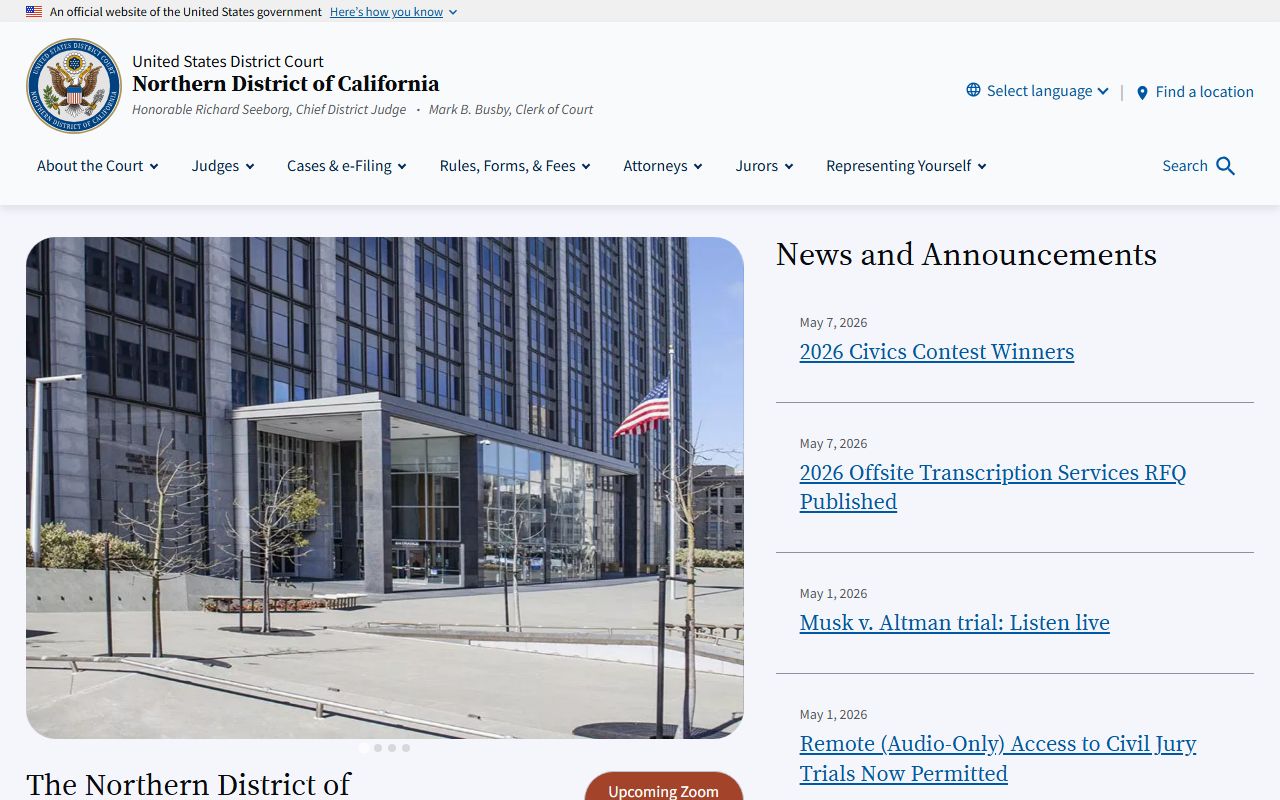
The same page links to PACER, CM/ECF, and the Ninth Circuit, which are the right tools for any federal case touching Sonoma County.
Court Locations and Contact Information
The Superior Court uses two main public-facing buildings in north Santa Rosa, plus separate juvenile and traffic locations as listed by the court. Confirm the right address for the case type before any visit. Security screening adds time, so plan ahead.
Hall of Justice (Main Court Campus)
Sonoma County Superior Court
600 Administration Drive
Santa Rosa, CA 95403
Criminal, traffic, jury, general court functions
Civil and Family Law Courthouse
Sonoma County Superior Court
3055 Cleveland Avenue
Santa Rosa, CA 95403
Civil, family, probate, small claims
The County Clerk-Recorder-Assessor, at 585 Fiscal Drive, Room 103, is a separate office. It handles marriage licenses, vital records, and recorded documents, not court case files. Court records run through the Clerk of the Superior Court. See Clerk of the Superior Court for direct court-clerk requests.
Note: Phones are usually allowed in Sonoma courtrooms, but no photo, video, or audio recording is permitted without prior court approval.
Sonoma Superior Court History
Sonoma County is one of California's original counties, created in 1850 when California became a state. The first California legislature passed an act on April 18, 1850 that established county clerk duties and the recording system, and California was admitted as the 31st state on September 9, 1850. Sonoma's court system tracks California's larger move from early county courts and municipal courts toward today's unified Superior Court.
California unified its trial courts in the late 1990s and early 2000s. Municipal courts were merged into the superior court in each county. Sonoma now has one Superior Court for all trial-level cases. That is why a researcher looking for a Sonoma "municipal court" or "county court" file from after unification will find a Superior Court case instead. Historical records from before unification may still bear earlier court captions.
The court's main campus is in north Santa Rosa near the County Administration Center. The same area holds the District Attorney, Public Defender, Sheriff's facilities, Probation, the Clerk-Recorder, and other county justice offices. This concentration makes Sonoma's justice campus easy to find but the wrong building for one task can still cost an hour.