
How to Find Sonoma County Marriage & Divorce Records
The first step is to pick the right office. The Sonoma County Clerk-Recorder-Assessor holds marriage license applications, recorded marriage certificates, and certified copies of those certificates. The court holds nothing about the marriage license itself. The court holds divorce cases, custody cases, support cases, and family law restraining orders. Two offices, two record sets, two fee schedules.
For marriage records, start on the Clerk-Recorder-Assessor page and click through to the marriage certificates section. Plan for ID, the marriage date or year, and the full legal names of both spouses at the time of marriage. The office accepts cash, checks, credit cards, and debit cards. Phone service runs Monday through Friday from 9:00 AM to 4:00 PM at (707) 565-3800. For 24-hour information, call (707) 565-3700. Email goes to ClerkRecorder@sonomacounty.gov.
For divorce records, the case lives in the Sonoma Superior Court family law division. Search the Odyssey Portal by party name or case number. The portal lists case header data, hearings, and the register of actions. Some documents are remote-viewable; others are courthouse-only under California Rule of Court 2.503. For older Sonoma family law files, contact the family law clerk at 3055 Cleveland Avenue.
The Sonoma County Clerk-Recorder publishes a dedicated marriage certificates page that explains how to order copies and what fees apply. View the source at the marriage certificates page.
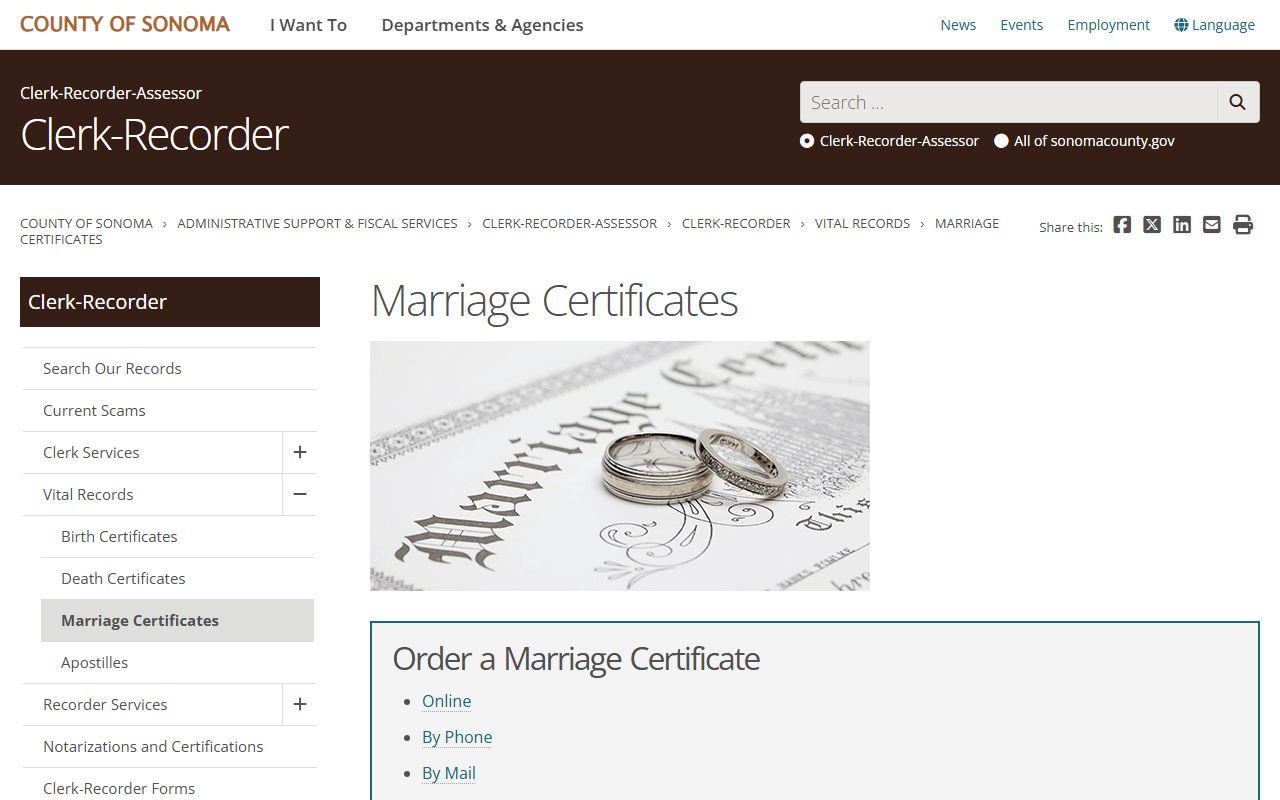
The same page lists the ordering options for in-person, mail, and online certified marriage certificate requests, plus the form used to verify a requester's relationship to the marriage.
Sonoma County Marriage License Process
A California marriage license is needed before any wedding ceremony in Sonoma County. The Clerk-Recorder-Assessor issues the license under state law. The County Clerk is the Commissioner of Marriages. Couples may apply at the office at 585 Fiscal Drive, Room 103, Santa Rosa. The license is good for 90 days from the issue date. After the wedding, the officiant returns the signed license to the Clerk-Recorder for recording.
The current Clerk-Recorder-Assessor is Deva Marie Proto. The office posts hours of Monday-Tuesday 8:00 AM to 5:00 PM, Wednesday 8:00 AM to 4:00 PM, and Thursday-Friday 8:00 AM to 5:00 PM. No fee transactions are handled within 30 minutes of close. Plan for that when booking a license appointment.
- Review the official marriage license page for current rules and any online pre-application.
- Complete the pre-application online if the county offers it for your license type.
- Both parties appear together at the Clerk-Recorder counter unless a confidential pre-application allows otherwise.
- Bring valid, unexpired, government-issued photo ID for each applicant.
- Disclose prior marriages or domestic partnerships and how each ended; bring date and manner if asked.
- Choose between a public license and a confidential license; declare in the application.
- Pay the license fee listed on the current Clerk fee schedule by cash, check, credit, or debit card.
- Use the license within 90 days; have an authorized officiant sign it; the officiant returns it for recording.
Once the signed license is back with the office, the marriage is recorded and certified copies of the marriage certificate can be ordered. Order at least one certified copy for legal use right away. Many couples order two or three for name changes, Social Security, and insurance.
Public vs Confidential Marriage License
California law offers two license types. A public license creates a public marriage record that anyone may request to view or copy. A confidential license is restricted: only the spouses, or a person with a court order, may obtain a copy after recording. The two are different products under the California Family Code, and the choice is made at the time of application.
A public license requires at least one witness at the wedding ceremony. A confidential license has different witness rules and an extra residency requirement under state law. Both result in a legal marriage; the difference is in who can later see the record. Couples should pick the option that fits their privacy goals and consult the Clerk-Recorder if unsure.
Marriage License Application Fields
The marriage license application asks for personal details about each applicant. Bring the listed items to the counter or have them ready for the online pre-application. The fields below reflect the standard California application as offered through the Sonoma Clerk-Recorder process.
| Field Label | Type | Required | Notes / Format |
|---|---|---|---|
| Applicant 1 legal name | text | Yes | Must match the photo ID. |
| Applicant 2 legal name | text | Yes | Must match the photo ID. |
| Date of birth | date | Yes | Used to confirm age eligibility under California law. |
| Address | text | Yes | Residence or mailing address for each applicant. |
| Identification type and number | text / dropdown | Yes | Government-issued photo ID. |
| Prior marriage or domestic partnership | text / date | Conditional | Date and manner ended; divorce, death, or annulment. |
| License type | radio | Yes | Public or confidential under the California Family Code. |
| Ceremony service | checkbox | Optional | Mark if a county civil ceremony is requested. |
Mistakes on the application are not easy to fix after the license is recorded. Spell each name as it appears on the ID, even if it differs from a passport or driver's license used in other states. The recorded certificate uses the names from the application.
Marriage Ceremonies in Sonoma County
The Clerk-Recorder offers civil marriage ceremonies as a county service. Couples may also be married by a deputy marriage commissioner. California law allows a friend or family member to be appointed a one-day deputy marriage commissioner through the Clerk's office. The deputy commissioner program lets a chosen officiant solemnize one wedding on a specific date.
Religious officiants, judges, retired judges, and other authorized officiants may sign the license under state law. The officiant signs the license, prints the date and place of marriage, and returns the document to the Clerk-Recorder for recording within the time limit. If the license expires unused, a new license must be issued.
Certified Marriage Certificate Copies
After recording, certified copies of the marriage certificate can be ordered from the Clerk-Recorder. A certified copy is the legal version of the record and carries the office seal. An informational copy may also be available, but it is marked "informational, not a valid document to establish identity." Many agencies will only accept certified copies for name changes, immigration, Social Security updates, or estate matters.
Order in person at 585 Fiscal Drive, by mail with the required form and fee, or online where the county supports it. For confidential marriage records, only the spouses or a court-authorized requester can obtain a copy. The Clerk-Recorder warns that no fee transactions are processed within 30 minutes of closing time. Plan a counter visit accordingly.
How to File for Divorce in Sonoma County
California is a no-fault divorce state. The only grounds are irreconcilable differences or permanent legal incapacity. A divorce is called a dissolution of marriage in California law. At least one spouse must meet California residency for six months and Sonoma County residency for three months before filing a standard dissolution. Legal separation may be available if residency is not yet met.
- Use the statewide forms from the California Courts self-help portal; the Sonoma self-help center also lists divorce packets.
- File the petition (FL-100), the summons (FL-110), and any local forms with the family law clerk at the Civil and Family Law Courthouse, 3055 Cleveland Avenue.
- Pay the filing fee or file a fee waiver application if income qualifies.
- Serve the other spouse with the petition, summons, and blank response forms; file the proof of service.
- Exchange preliminary and final financial disclosures, including income, expenses, assets, and debts.
- Resolve custody, support, and property issues by agreement, default, mediation, or contested hearing.
- Submit a proposed judgment; the court enters judgment after the statutory six-month waiting period from the date of service.
The case is final only when the court signs the judgment and the six-month wait has run. Until then, the parties are still legally married for many purposes. Custody, support, and property orders may be modified later if the law allows.
Sonoma County Divorce Records in the Court Portal
Sonoma divorce cases are searched through the Sonoma Superior Court Odyssey Portal. Search by petitioner or respondent name, or by case number when known. The portal shows the case header, hearings, judgment status, and the register of actions. Financial disclosures, custody evaluations, and minor information may be sealed or not available remotely.
For older Sonoma family law cases, contact the family law clerk directly. Provide the parties' names, the approximate filing year, and any partial case number. For certified or exemplified copies of the judgment of dissolution, request through the court clerk and pay fees under Government Code section 70627.
The portal does not replace the courthouse for every record need. A custody evaluation, a sealed declaration, or a confidential address may only be reviewed in person under the court's rules. The court may also limit access for safety in domestic violence cases. Plan for a courthouse trip if the file involves restraining orders or minor children.
Confidential Family Law Materials
Several parts of a Sonoma divorce file are confidential or redacted by default. Custody evaluations, mediator reports, minor witness statements, and Social Security numbers are kept off the public docket. Confidential addresses are protected when a party qualifies under Family Code safety provisions. Adoption records linked to a family law matter are confidential under Family Code section 9200.
To unseal or view a restricted family law record, a party usually files a motion and shows good cause. The court rules on access through a written order. A clerk at the counter cannot release confidential materials without that order. This protects parties and minors during the case and after.
Fees for Marriage and Divorce Records
Two fee schedules apply. Marriage license, confidential license, ceremony, certified marriage certificate, and informational copy fees come from the Clerk-Recorder fee schedule. Divorce filing, certified judgment copies, and exemplified copies come from the Sonoma Superior Court fee schedule under the Government Code. Confirm exact current amounts on the official schedule before sending payment.
| Item | Office | Amount |
|---|---|---|
| Marriage license (public) | Clerk-Recorder | See official Clerk fee schedule |
| Confidential marriage license | Clerk-Recorder | See official Clerk fee schedule |
| Civil ceremony | Clerk-Recorder | See official Clerk fee schedule |
| Deputy marriage commissioner appointment | Clerk-Recorder | See official Clerk fee schedule |
| Certified marriage certificate copy | Clerk-Recorder | See official Clerk fee schedule |
| Divorce filing fee | Sonoma Superior Court | Per court fee schedule under Gov. Code § 70627 |
| Response filing fee | Sonoma Superior Court | Per court fee schedule under Gov. Code § 70627 |
| Certified copy per page | Sonoma Superior Court | Per Gov. Code § 70627 |
| Certification fee | Sonoma Superior Court | Per Gov. Code § 70627 |
Fee waivers are available for litigants who meet income limits. The Judicial Council form FW-001 starts the request. The court rules on the waiver and may require an income hearing in some cases. The Clerk-Recorder fee schedule is set by county ordinance and state law, and cannot be waived in the same way as a court filing fee. The current Clerk fee schedule page lists all current amounts.
The county also publishes the Recorder fee schedule for recorded documents, which includes recorded marriage certificate copies and recorded ceremony records. View the source at the Recorder fee schedule page.
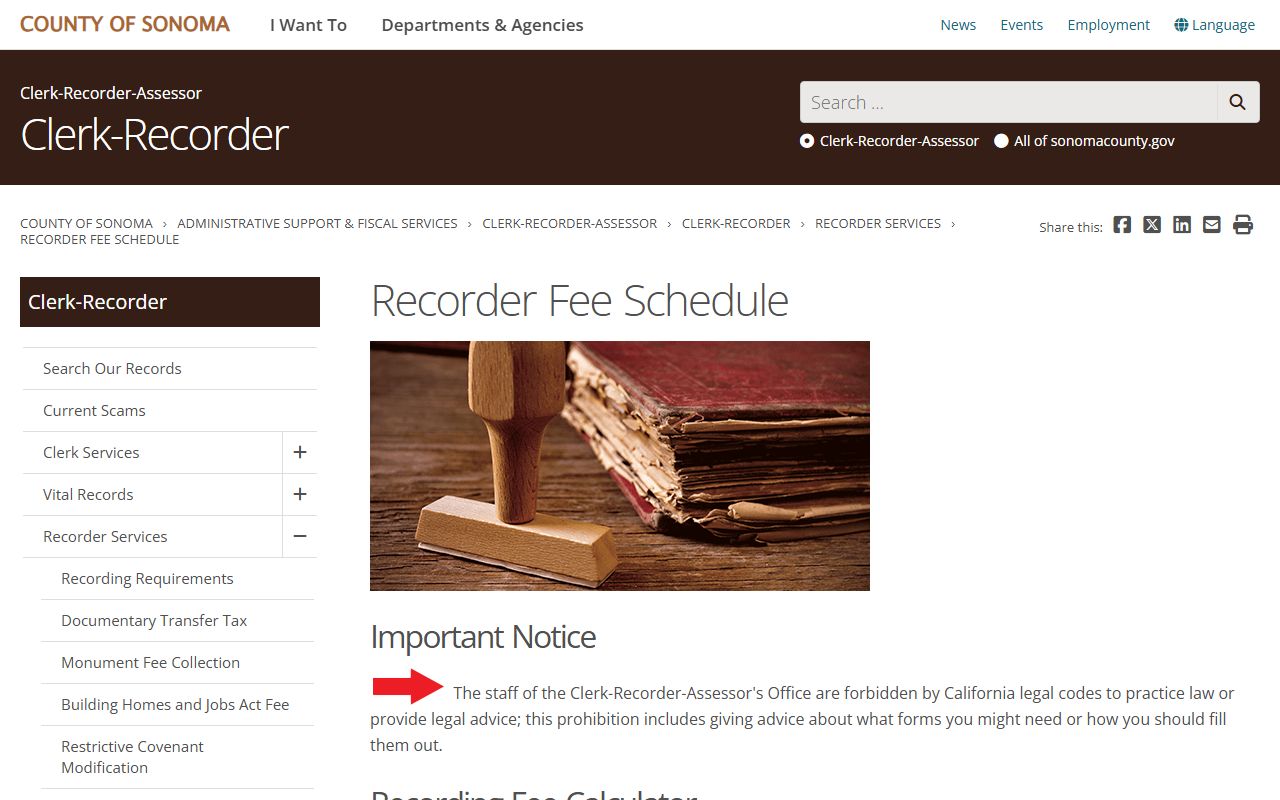
The Recorder schedule covers base recording fees, indexing, surcharges, and copy fees for recorded items, which is the official source for Sonoma County recorded marriage certificate copy costs.
Note: The Clerk-Recorder will not process fee transactions within the last 30 minutes of any business day, so plan counter visits early.
Sonoma County Clerk-Recorder Contact
The Clerk-Recorder office is the single best contact for marriage license, ceremony, deputy commissioner, and marriage certificate copy questions. The office sits in north Santa Rosa near the county justice campus, but it is a separate building from the Hall of Justice and the Civil and Family Law Courthouse.
Sonoma County Clerk-Recorder-Assessor
Clerk-Recorder: Deva Marie Proto
585 Fiscal Drive, Room 103
Santa Rosa, CA 95403
(707) 565-3800
24-hour info: (707) 565-3700
Fax: (707) 565-3905
ClerkRecorder@sonomacounty.gov
Mon-Tue 8 AM-5 PM, Wed 8 AM-4 PM, Thu-Fri 8 AM-5 PM
Civil and Family Law Courthouse
Sonoma County Superior Court
3055 Cleveland Avenue
Santa Rosa, CA 95403
Family law division for divorce filings
For court-side questions about a Sonoma divorce, custody, or support case, use the family law division directly. The clerk at the family law counter handles filings, copies, and case status checks. The Clerk-Recorder cannot release a court file, and the court cannot release a marriage certificate.